Key takeaways
- "Christian curriculum" describes two different products: faith woven through every subject (Abeka, BJU Press) versus a strong academic core with Bible taught alongside it (Sonlight, Memoria Press). Most families never learn the difference before they buy
- You can subtract faith content from the second kind. You cannot subtract it from the first, because integration is the product
- Real 2026 prices span roughly 25x: free (Easy Peasy) to about $190-$415 a grade (Master Books) to $1,000-$1,900 a year (Abeka, BJU Press, Sonlight, Memoria Press)
- 75% of homeschool parents cite moral instruction as an important reason for homeschooling, though only 13% name religious instruction as their single most important one[1]
Ask ten Christian homeschool parents which curriculum to buy and you'll get ten confident answers, most of them naming whichever program that family already owns. What almost nobody tells you first is that "Christian homeschool curriculum" is not one category. It is at least two products that behave very differently once they're on your kitchen table, and buying the wrong one is the single most expensive mistake in this market.
This guide sorts twelve programs by how deeply faith is actually integrated, prices every one of them against the publisher's own 2026 pricing page, and tells you what each gets wrong as clearly as what it gets right. There is no house product hiding in the rankings.
Two Different Products Share One Name
Here is the distinction that should drive your decision, and the one the rest of the internet organizes around denomination instead.
Faith woven through every subject. Abeka, BJU Press, Master Books and Easy Peasy build a biblical worldview into the material itself. Scripture shows up in math word problems. History is narrated as providence. Science teaches a young-earth creation account as the framework, not as one view among several. The Bible is not a class you schedule at nine o'clock; it is the lens on everything from nine to three.
A strong academic core with Bible alongside. Sonlight, Memoria Press, Notgrass and My Father's World teach reading, math and history on their own terms, then run faith as a real but separable strand: a Bible reading plan, a catechism, a devotional component, a Christian selection of literature. The faith is genuine. It is also modular.
Faith-neutral, which is not the same as anti-Christian. A third group simply stays silent on origins and theology. Neutral does not mean hostile; it means the publisher declined to take a position and left it to you.
The practical consequence is an asymmetry almost nobody names: you can subtract faith content from the second kind. You cannot subtract it from the first. Families buy a woven-through program planning to skip the parts they disagree with, then discover there is nothing to skip, because the worldview is the connective tissue. One mother described handing her son a science report topic, watching him research it from non-curriculum sources, and finding he had still written a bullet point about scientists being wrong about the age of the earth. That is not a bug in an integrated curriculum. That is the curriculum working.
Get this one question settled before you shop, and most of the reviews that seem to contradict each other stop contradicting each other. The bad reviews are usually written by families who landed in the wrong camp, not by families who bought a bad product.
Woven Through vs. Bible Alongside
How We Picked
Four rules shaped this list.
First, every price was read off the publisher's own pricing page in August 2026, not copied from another roundup. This matters more than it sounds: the same program is quoted at $450, at $800 and at $1,750 across three competing articles, and at least two of those are wrong. Where a sale was running we published list price, because sales expire and articles don't.
Second, programs are sorted by faith-integration depth, not by rank. A curriculum that is perfect for one family is unusable for the family next door, and the reason is almost always this axis rather than quality.
Third, every entry gets its real drawbacks. Some of the most heavily marketed programs in Christian homeschooling have the weakest reputations among parents who have used more than one. Saying so is the job.
Fourth, no self-ranking. Numa is a homeschool management platform, not a curriculum publisher, so there is no house product on this list. (We are building some things in this space, and that will be worth a look when it lands.) What Numa does today is hold whatever you choose together: state requirements, scope and sequence mapping, attendance, records, transcripts.
One caveat on our own coverage: Christian Light Education declined to surface current pricing to us, so it appears in the write-ups below without a dollar figure rather than with a guessed one.
Christian Homeschool Curriculum Compared: Verified 2026 List Pricing
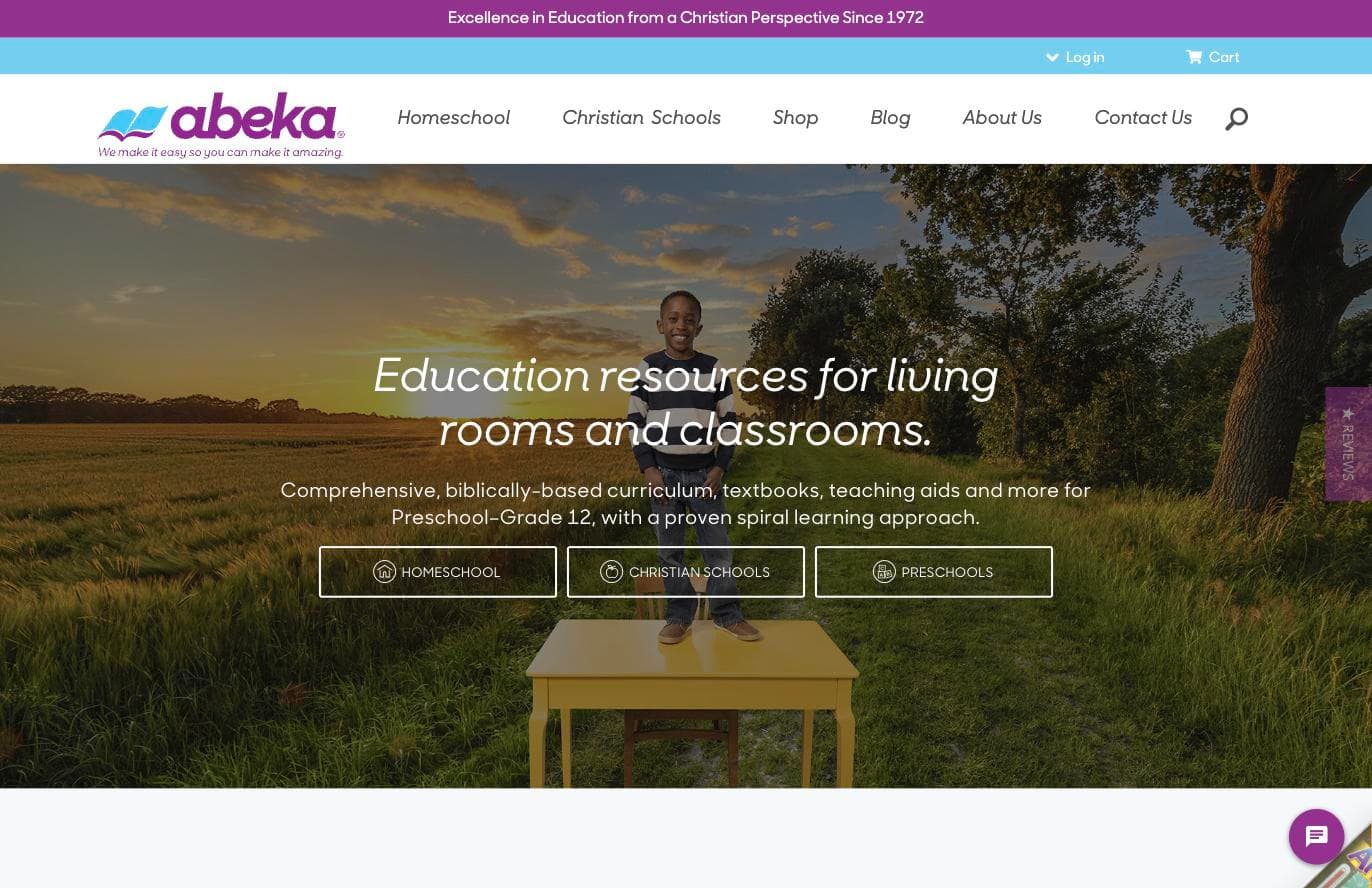
1. Abeka: Best Phonics, Heaviest Workload
Abeka has been the default name in Christian homeschooling since 1972, and it earns the reputation in exactly one place: reading. Its phonics program is genuinely excellent and gets recommended even by parents who abandoned everything else Abeka sells. The spiral math is solid. The traditional structure means nothing falls through the cracks.
Price. Parent-led print runs roughly $865 to $1,880 for a full grade once you buy both the child kit and the parent kit[2]. Abeka Academy, the enrolled video option, is $148.40 a month for grades 1 through 6 and $188.40 for grades 9 through 12 on the accredited plan, so about $1,484 to $1,884 a year per student. The accredited tier differs from the unaccredited one mainly in that Abeka grades the work.
What parents actually report. Two complaints dominate, and they are consistent enough to plan around. The workload is punishing: video days routinely run hours, and "busywork" is the word that recurs. And the "a grade ahead" claim is front-loaded. Abeka does move faster in the early years, largely through memorization, and veteran families report the advantage inverting by middle school, where breadth substitutes for depth.
The history and science draw the sharpest criticism, including from families who share Abeka's theology and simply find the treatment one-sided. The widely repeated compromise: keep Abeka phonics and language arts, source history and science elsewhere.
Best for. Families who want maximum structure, want faith in everything, and have the stamina for the pace. Buy the language arts first and test your tolerance before committing a full grade.
2. BJU Press: Best Woven-Through Option for Thinking Skills
BJU Press occupies the same theological ground as Abeka but teaches differently, and the comparison homeschoolers repeat is a fair one: Abeka orients toward memorizing facts, BJU Press toward building a conceptual framework. Its materials are newer, better looking, and more willing to present an opposing argument before answering it.
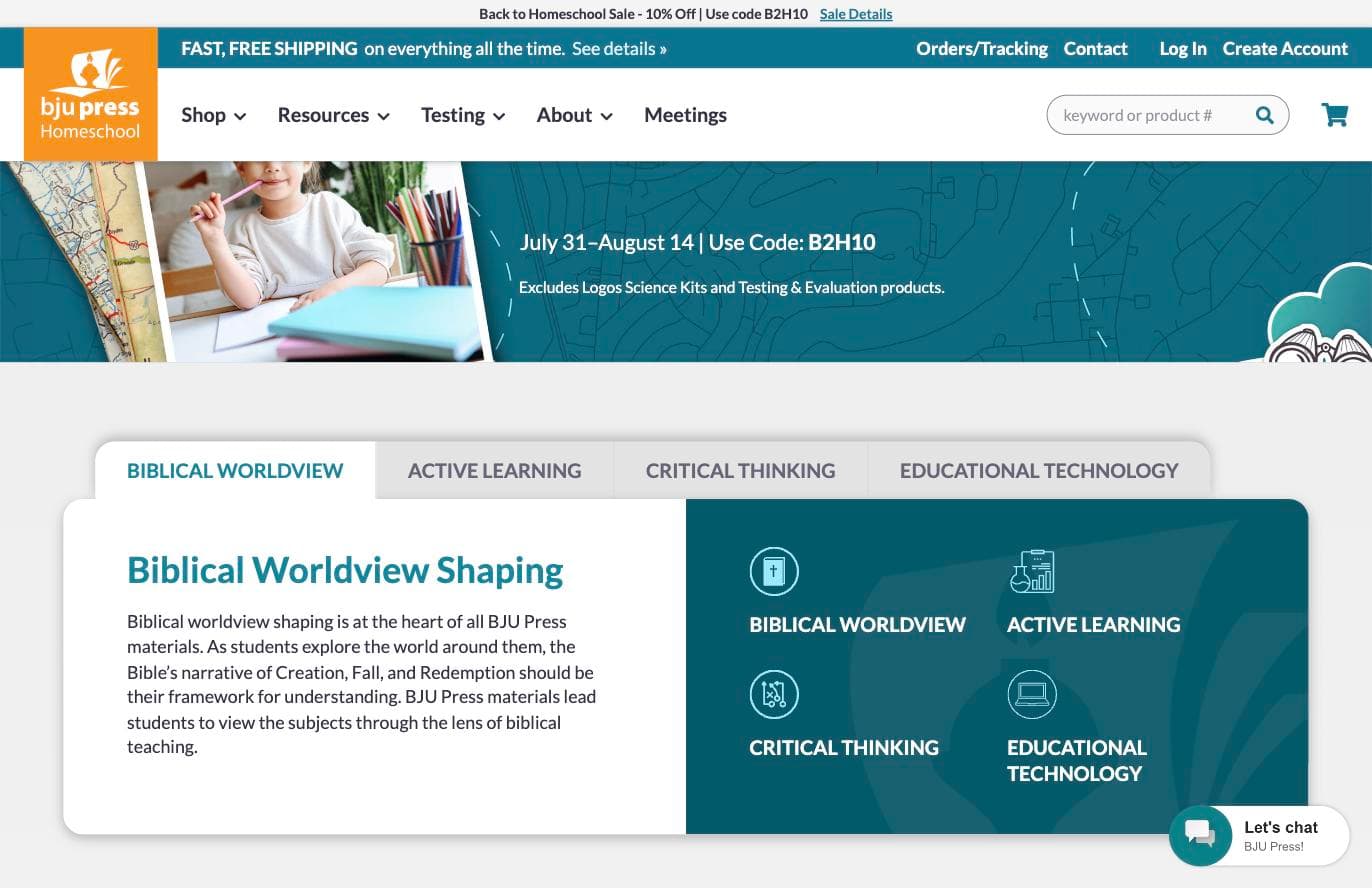
Price. Refreshingly simple, and flat across grades 1 through 12: $979 for the online video kit, $1,149 for online with printed books, $1,209 for DVD with books[3]. The parent-led textbook kit without video runs about $1,009 to $1,073. Single subjects start at $99 online. The Homeschool Hub learning platform is included rather than sold separately, and it will track courses from other publishers too, which is unusually generous.
What parents actually report. The strongest praise is that students come out able to argue a position rather than recite one. The most common practical complaints are the price and the parent prep on textbook-only kits. One specific weakness worth knowing: reading specialists report seeing more remedial students from BJU's early reading program than from any other, because it leans harder on sight words than pure phonics.
On accreditation. BJU's Academy of Home Education adds $479 a year for the accredited track plus a one-time application fee, on top of curriculum you buy separately. Note that neither BJU nor Abeka names its accrediting agency anywhere we could find on their sites, which is worth a phone call before you pay for the tier.
Best for. Families who want a thoroughly integrated Christian worldview without Abeka's drill load, and who value a curriculum that teaches its students to reason toward its conclusions.
3. Master Books: Best Budget Faith-First Curriculum
Master Books is the cheapest way to buy a fully Christian, fully integrated curriculum, and it is not close. A grade-level Basic 4 Subject Set lists at $188.96 for kindergarten and $242.94 for third grade, rising to about $400 to $414 for the high school sets[4]. That is roughly a fifth of what Abeka, BJU Press or Sonlight cost.
It is open-and-go in a way that genuinely respects a tired parent. Lessons are short, the "living education" math is narrative rather than drill-based, and there is no teacher's manual to decode.
The honest tradeoff. Master Books is academically light, and its users mostly know it. Parents who have taught from other programs describe the math in particular as remedial for the stated grade, and the criticism that it runs behind grade level is common enough that you should plan on supplementing math no later than middle school. Master Books is published by Answers in Genesis, so young-earth creation is not a lean, it is the foundation, and Ken Ham's material is woven throughout.
The parents who love it are usually explicit about the trade they are making: they are optimizing for formation and sustainability over academic ceiling, and they would make the same choice again. That is a legitimate position, and it is a much better reason to buy Master Books than the belief that it competes academically with the expensive programs.
Best for. Large families, tight budgets, and parents who want faith-first material they can actually finish, paired with a stronger standalone math program.
4. Easy Peasy All-in-One: Best Free Christian Curriculum
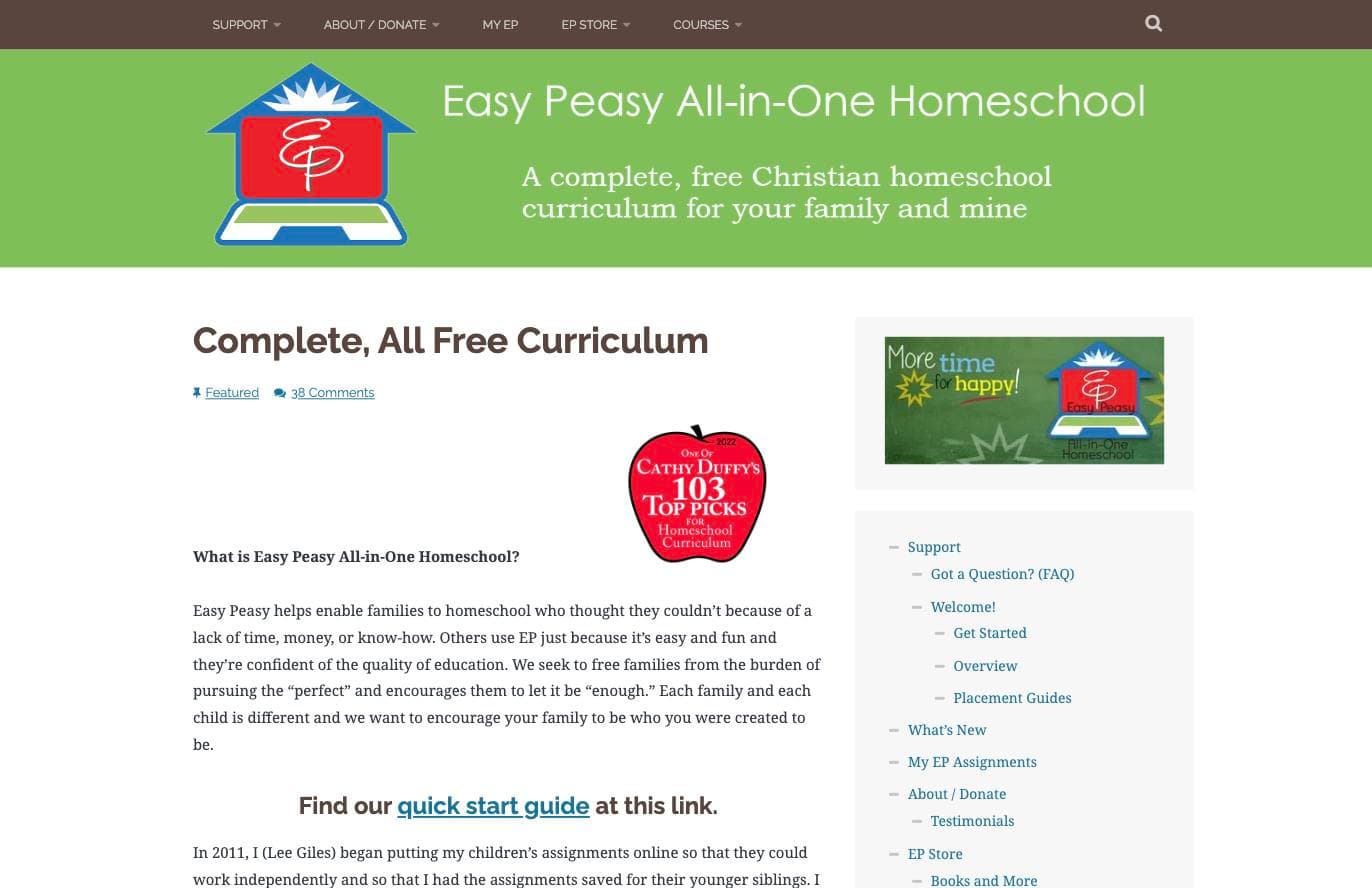
Easy Peasy is a complete, fully planned, genuinely free Christian curriculum covering preschool through eighth grade on the main site, with high school on a companion site. Not a free trial, not a free sample. Free, including Bible, Spanish, logic, music and art[5].
Families run it for years and are happy. It is short, direct, and requires only a cheap workbook and an internet connection.
What it costs you instead. Assembly. The curriculum is written from a conservative, young-earth Protestant perspective, and it is thoroughly integrated: a language arts reading passage may be Scripture, and a science lesson will teach creation as fact. Parents who want it without that swap out history and science and keep the rest, which works precisely because the faith content is dense but clearly located. Beyond worldview, the recurring critiques are gaps in sequence and thin practice, especially in math, and a reading program that leans more whole-word than phonics. Pair it with a real phonics program and a real math program and it holds up remarkably well.
Best for. Families who need a complete curriculum at zero cost and can supply the two subjects that need shoring up. Also a sensible way to test whether a woven-through approach suits you before spending $1,200 finding out.
5. Christian Light Education: Best Value Almost Nobody Markets to You
Christian Light is the program experienced homeschoolers recommend to each other and that new homeschoolers have never heard of, which tells you something about the relationship between marketing budget and quality in this market.
The description parents give is remarkably consistent: open-and-go, cost-efficient, no outside materials required, developmentally sensible expectations, and (the phrase that keeps recurring) solidly but not obnoxiously Christian. It is built around small sequential LightUnit worktexts that foster independent work, which makes it unusually workable when you are teaching several children at once. The math and language arts strands get the strongest reviews.
The caveat. Christian Light is a Mennonite publisher, and the Reading strand reflects it. Expect a great many farm stories and a rural, plain-living sensibility. Some children love it; others tire of it, and swapping the Reading strand for something else while keeping math and language arts is a common and easy fix.
On pricing. We could not verify current grade-set pricing from Christian Light's own site, so we are not publishing a figure. Families consistently describe it as inexpensive relative to the major publishers, and it is sold per subject rather than as an all-or-nothing grade package, which is part of the appeal.
Best for. Families who want genuinely Bible-centered material without Abeka's price or workload, and who like the idea of children working through a subject with growing independence.
6. Sonlight: Best Literature-Based Christian Curriculum
Sonlight replaces textbooks with books. Real ones: award-winning novels, biographies, primary sources, roughly fifty a year, tied together by an Instructor's Guide that tells you what to read and what to ask. Children raised on it tend to become readers, and graduates say so even when they criticize other parts of the experience.
Price. All-Subjects Packages run from $463.72 for preschool to $1,745.44 at the sixth-grade level, with most full grades landing between $1,065 and $1,600[6]. That is the top of this market. Two mitigations: the cost is mostly books, which hold resale value and can be reused with younger siblings, and Sonlight's book lists are public, so library-based families borrow the structure without buying the box.
What parents actually report. The read-aloud load is the real cost. Sonlight expects significant daily parent time, and burnout is the most common reason families leave. The other recurring critique comes from graduates who found the historical selections tilted, particularly on colonialism and the Civil War, and from Christian families who object to how some titles frame Catholic and Orthodox countries.
Worth knowing: Sonlight is closer to the Bible-alongside model than its reputation suggests. It deliberately includes mainstream books and flags passages rather than sanitizing them, which is why some families find it too neutral and others find it too Christian.
Best for. Families who genuinely enjoy reading aloud together and want history and literature to carry the year. If you are not sure that describes you, borrow the book list first.
7. My Father's World: Best for Teaching Several Children Together
My Father's World is the gentle, family-style all-in-one where the Bible really is the spine rather than a decoration, and it is the program most often recommended to overwhelmed parents of multiple children.
Price, and the structural detail that matters most. Packages run from $265.17 for kindergarten essentials to about $650 for high school[7]. But the number to notice is that grades 4 through 8 share a single "Family Cycle" package: one purchase teaches several children at once. Against Sonlight, BJU Press, Abeka Academy and every online school, all of which charge strictly per student, that inverts the ranking for a family of three.
What parents actually report. The most common surprise is that it looks too simple and isn't. Parents who expected it to underchallenge report the opposite. The most common complaint is prep: hands-on projects and experiments need setup, and this is a parent-led program, not a hand-off. Science leans on Master Books and Answers in Genesis material, so the young-earth framing arrives with it.
Best for. Multi-child families who want everyone learning the same thing at the same time, with Bible as the organizing thread and a workload a real human can sustain.
8. The Good and the Beautiful: Best Gentle On-Ramp, With Real Caveats
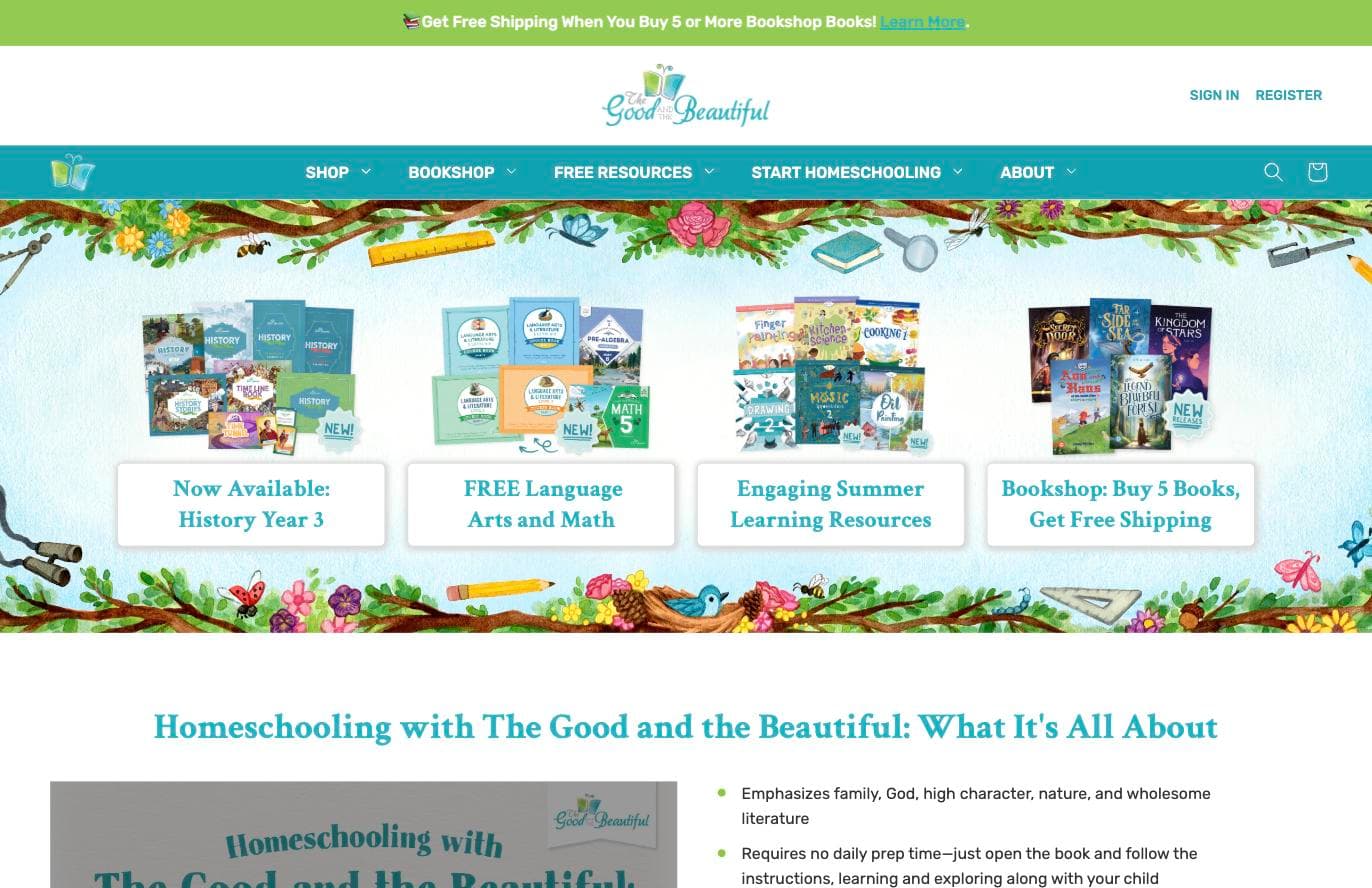
The Good and the Beautiful is beautiful, inexpensive, and the program most likely to be the first one a new homeschooler encounters. Language arts courses run $20.99 to $125.92 and math $49.98 to $89.95, with free sample PDFs and free placement tests for every level[8]. Full courses are available as free downloads. For a family testing whether homeschooling is survivable, that is a genuinely good on-ramp.
Two caveats, and the one people worry about is the wrong one.
The concern evangelical families raise is that the founder is Latter-day Saint. The proportionate answer, from Catholic and Protestant families who have used it: the consulting board spans denominations, the religious content is deliberately broad, and the publisher's own framing is a Christian worldview without doctrine specific to any denomination. There is a subtle Mormon inflection in recurring themes if you know what to look for. For most families it is not the reason to pass.
The real objection is academic. Reading tutors report a steady stream of children arriving from this program unable to read, because new letters are introduced faster than they are practiced. The math is procedural rather than conceptual: it teaches the how without the why, and children can complete a level ahead of grade while failing another publisher's placement test for the grade below. The pattern is well-known enough to plan around.
Best for. Preschool through early elementary as a low-cost, low-stress start, and for children who need short, visually calm lessons. Pair it with a dedicated phonics program and a conceptual math program, and it works. Treat it as a complete education and you will be filling holes in sixth grade.
9. Notgrass History: Best Christian History and Literature Spine
Notgrass is the quiet success story of this list: rarely marketed hard, rarely complained about. It is the answer for families who want history taught from a Christian perspective without a program that preaches at them, and its high school courses bundle history, English and Bible credit into a single purchase, which simplifies both your budget and your transcript.
Price. Elementary bundles pairing the curriculum package with its literature package run $120 to $150. Full-year high school bundles run $263 to $275, and single-semester courses like Exploring Government or Exploring Economics run $123 to $155[9]. No teacher's manual required, and it is designed for several children to work through together.
What to expect. Notgrass is more Christian than secular shoppers anticipate. It is designed to glorify God and says so, and families looking for a neutral geography or history spine regularly discover this after purchase. Within the Christian market the tone is well judged. The main dissent concerns the government and economics titles, which some families find flat.
Best for. Anyone assembling their own curriculum who wants one strong Christian humanities strand, and high schoolers who need history, literature and Bible to produce clean credits. Our history curriculum guide covers the wider field.
10. Memoria Press: Best Classical, and Genuinely Modular
Memoria Press is the most rigorous program on this list and the most polarizing. It is classical in the full sense: Latin from the early grades, Great Books, memory work, and a structure that tells the teaching parent exactly what to do rather than suggesting a nature walk.
Price. Curriculum sets list at $672.01 for first grade, $1,143.77 for third, $1,207.84 for seventh and $1,463.31 for ninth[10], with consumables sold separately. Sales are frequent and steep.
Why it belongs in the Bible-alongside column. Memoria Press is modular in a way the woven-through programs are not. Its phonics and reading program is strong and essentially non-religious, and families routinely buy that strand alone. The Christian studies and science are separate purchases you can take or leave. That flexibility is a real feature.
The honest warnings. It is intense, and the intensity arrives early. Families report the writing load in the early grades as developmentally aggressive, and the junior kindergarten worksheets draw sharp criticism even from parents who love the book lists. If you have a child who frustrates easily, this is not a gentle first year. The reading list is heavily Western and European by design, which is the point for some families and a limitation for others.
Best for. College-bound students, parents who want concrete daily instructions, and anyone who wants excellent phonics or Latin as a standalone purchase.
Single-Subject and Specialist Picks
Most experienced Christian homeschoolers build a stack rather than buying one publisher for everything. The advice veterans give newcomers is nearly unanimous on this point: one publisher's voice across every subject gets tiresome, and it burns families out faster.
Apologia (science, $94 for elementary and middle school sets, $121 for high school). The default Christian science curriculum, and the split verdict is interesting. Graduates who criticize its worldview still say the high school courses prepared them for college science better than the alternatives. Other parents find it under-informative for state testing and heavy-handed in its digressions. It teaches young-earth creation as the framework. Old-earth and mainstream-science Christian families usually look at Novare, Berean Builders, Science Shepherd or CSI instead. Our science curriculum guide works through that decision properly.
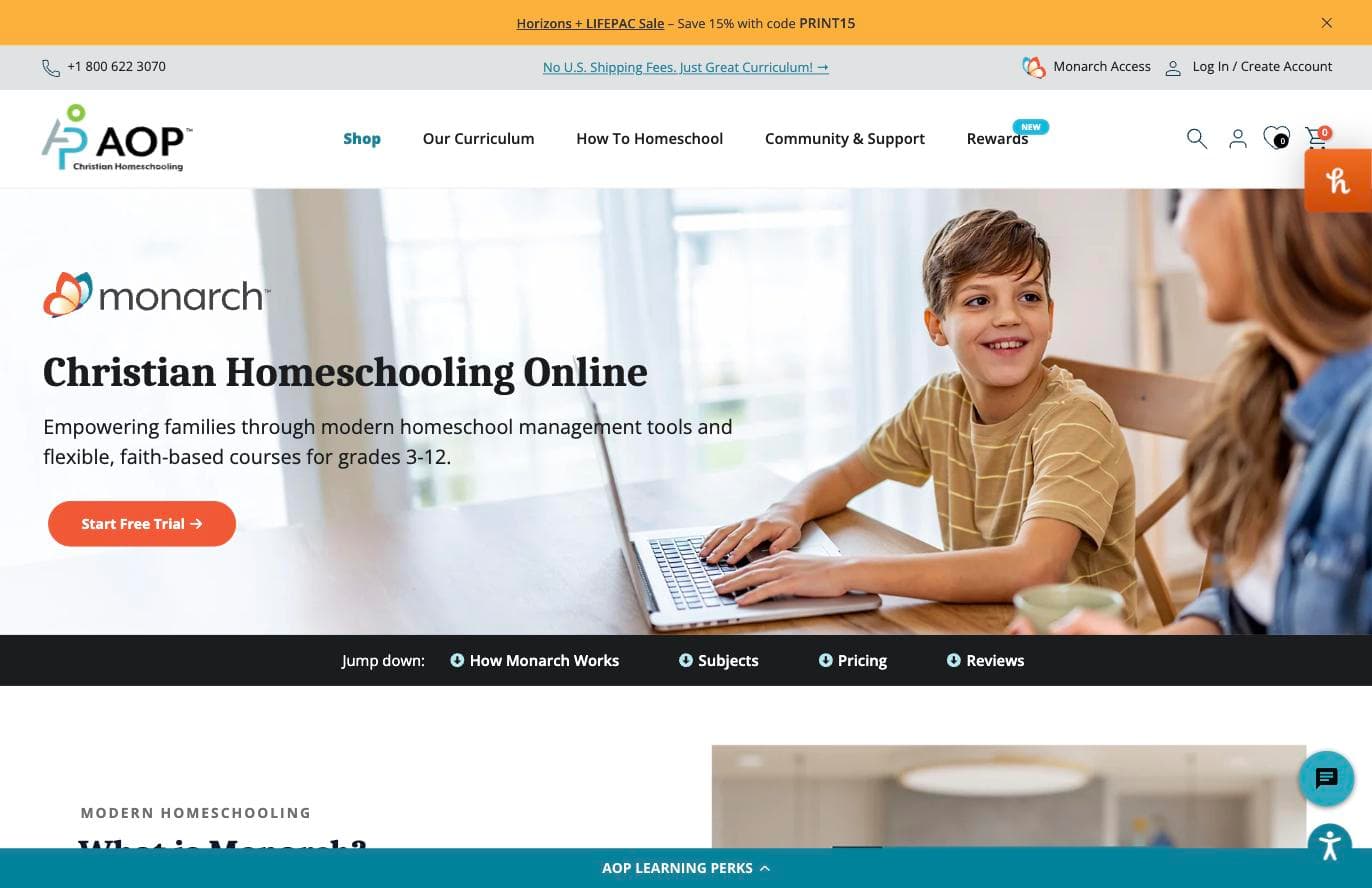
Monarch, from Alpha Omega ($439.95 a year, grades 3-12). The most affordable fully online Christian option: all 100-plus courses for one price, about 85% auto-graded, widely accepted by ESA programs. A single course is $109.95 a year. Worth knowing that Switched-On Schoolhouse and Ignitia are discontinued, so any roundup still recommending them is out of date. Alpha Omega's print lines remain: LIFEPAC complete grade sets run $468 for grades 2 through 12, Horizons $375 to $425 in the early grades.
Veritas Press (self-paced online, $199-$349 per course). Strong classical Bible and history courses that children genuinely engage with, plus live online classes through Veritas Scholars Academy at roughly $829 a course. Two things families should know going in: the Omnibus program has a documented plagiarism history the publisher addressed with errata rather than a recall, and the wider network has associations that a number of Christian families investigate before buying.
Bible as its own subject. If you are running a neutral academic core, this is the piece you add. Answers Bible Curriculum is $39.99 a year for the teacher guide and $34.99 per student book. Grapevine Studies teaches through stick-figure drawing at about $75 for the teacher book. Bible Study Guide for All Ages is the cheapest serious option at under $10 a student. Our Bible curriculum guide compares them in detail.
The Third Path: A Neutral Core Plus Your Own Bible Spine
There is a pattern satisfied Christian homeschoolers converge on that almost no roundup names as a legitimate strategy, largely because nobody sells it: buy the best academic tool for each subject regardless of worldview, and supply the faith integration yourself.
In practice that looks like Singapore, Math Mammoth or Beast Academy for math, All About Reading or Logic of English for phonics, Story of the World or Notgrass for history, a mainstream science program, and then a real Bible spine of your own. A family reading plan, a catechism, memory verses, Sunday school doing the theological work. Families who do this describe it not as a compromise but as the obvious move.
The economics make the point sharply. Sonlight and BookShark are the same company running the same literature-based method; BookShark is the version with the Bible removed. Level A costs $883.92 from BookShark and $1,125.61 from Sonlight[11]. Roughly $240 is what that particular faith integration costs, and some families would rather keep the $240 and do the integrating themselves.
The argument against outsourcing it is worth taking seriously too. Integration done well teaches a child to see connections a nightly devotional cannot. The argument for it is that you know your family's theology better than a publisher in another state does, and you will never have to correct your own curriculum. Neither answer is more Christian than the other. Our guide to choosing homeschool curriculum walks the general framework, and the secular curriculum guide covers the neutral-core half of this stack.
Christian Curriculum Under $500 a Year
Which Christian Curriculum Is the Most Rigorous?
This gets asked constantly, so here is the short honest answer. Memoria Press is the most academically demanding program on this list, followed by BJU Press for conceptual depth and Apologia at the high school level for science specifically. Abeka feels rigorous early because it moves fast, but the pace is driven by memorization, and memorizing more facts sooner is not the same thing as thinking harder about them.
The more useful reframe: rigor is a property of the match, not the box. A demanding curriculum a child refuses to do produces less learning than a moderate one finished daily. Every experienced homeschooler has watched a family buy the hardest program available and quietly stop by November.
Three Questions With Short Answers
Does accreditation matter? Usually not. Accreditation attaches to schools, never to curriculum, so no curriculum on this page is accredited no matter how it is advertised. No state requires homeschoolers to use accredited materials. It matters if your child may transfer into a brick-and-mortar school, or if you want a diploma issued by an institution rather than by you. Then you are shopping for an enrolled program, not curriculum: Abeka Academy, BJU's Academy of Home Education, Enlightium Academy ($1,500 to $2,800 a year, and the only one in this research that publicly names its accreditors, Cognia and ACSI), Liberty University Online Academy ($2,196 to $3,568.50), or Sevenstar. Ask any of them to name their accrediting agency before you pay, because most do not publish it.
What about Catholic curriculum? Catholic families have genuinely different needs, including sacramental preparation and the Catechism, and the good options are their own conversation. Start with our Catholic homeschool curriculum guide rather than adapting a Protestant program.
Do I have to teach young-earth creation? No, though the market makes it feel that way. Most Christian curriculum assumes a young-earth framework, and families who hold old-earth views or accept evolution while affirming God as Creator often assume nothing exists for them. Novare, Berean Builders, Science Shepherd, BioLogos and CSI all do. Our science curriculum guide treats this at length. If you and your spouse disagree about it, settle that before you shop, not after.
What Families Wish They Had Known Before Buying
The most useful reviews come from parents three months in, and their lessons repeat with striking consistency.
- Buy by subject, not by publisher. Almost nobody sticks with one company for everything. Committing to a single voice across all subjects is the fastest route to burnout for parent and child alike.
- Your first purchase is data, not a verdict. Veterans reframe it the same way independently: you now know something specific about what your family needs. That is not a wasted $400, that is a paid lesson.
- Give it six weeks before you judge. Most programs have a learning curve. If one or two pieces are failing, supplement rather than replacing the whole thing.
- Use the free samples. Nearly every publisher here posts sample lessons or placement tests, and almost nobody looks at them before spending four figures.
- Check per-student versus per-family pricing. For three children this changes the ranking completely. My Father's World and Notgrass teach several kids from one purchase; Sonlight, BJU Press, Abeka Academy and every online school charge per child.
- Sunk-cost guilt is real and worth naming. Abandoning a curriculum you paid for feels like failure and is not. Finishing a book was never the point.
Before You Buy: A Seven-Point Check
- Decide where you land on faith integration
Woven through every subject, or a strong academic core with Bible alongside? Settle this with your spouse first. It eliminates most of the market instantly.
- Settle your position on origins
Most Christian science curriculum assumes young-earth creation. If that is not your view, you need to know it before you buy, not in October.
- Read one history lesson and one science lesson
Not the marketing page. The actual lesson. This is where worldview shows up, and every publisher on this list posts samples.
- Price it per child, for your actual family
A $500 family-cycle package can beat a $250 per-student one the moment you have three children.
- Check the reading and math programs separately
These two carry everything else. Several otherwise good Christian programs are weak in exactly these places.
- Be honest about your daily capacity
Sonlight expects hours of reading aloud. Master Books expects very little. Buy for the parent you are on a hard week.
- Confirm the current price with the publisher
Sales, list prices and shipping thresholds move constantly, and most review sites carry outdated figures.
The Bottom Line
Searching for Christian homeschool curriculum is hard because the phrase covers two incompatible products, priced from nothing to nearly two thousand dollars a year, described in identical warm language. Settle whether you want faith woven through every subject or a strong academic core with Bible alongside it, and the field narrows to a few real candidates while the contradictory reviews start making sense.
Then start smaller than feels responsible: one subject, six weeks, a free sample first. Changing course later is normal. If you want a second opinion from someone who has seen a few hundred of these decisions, talk it through with us. Whatever you teach from, Numa holds the plan, records and state compliance in one place.
Frequently Asked Questions
Ready to simplify your homeschool?
Numa helps you track compliance, manage records, and plan your curriculum—all in one place.
Sign Up